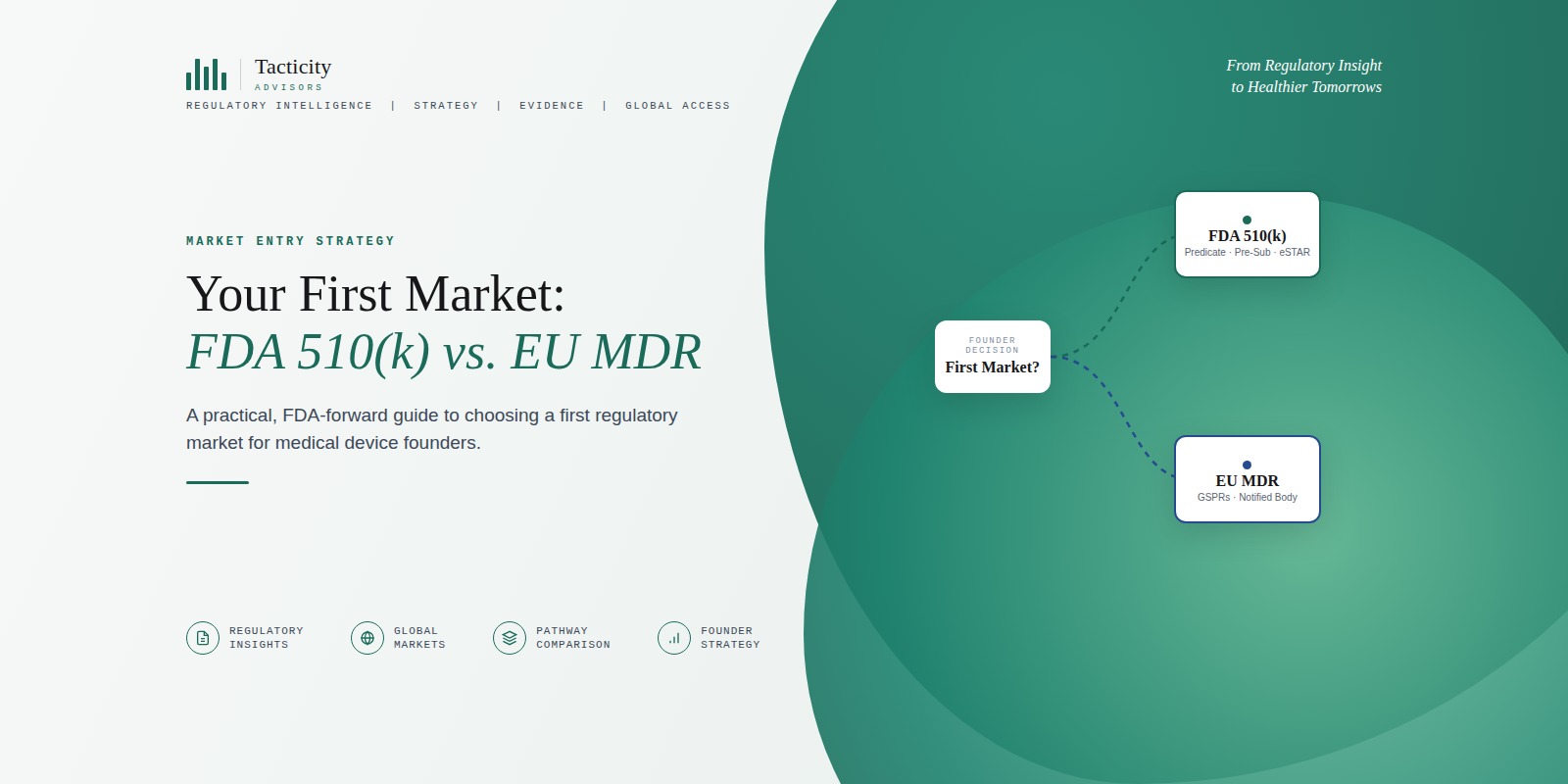
Choosing your first regulatory market is more than a compliance decision. It can shape your launch timeline, regulatory budget, evidence strategy, and route to international growth. For a medical device company preparing to enter international markets, two important options are the United States and the European Union. Both offer significant commercial opportunities, but their regulatory systems work differently.
The US Food and Drug Administration (FDA) follows a pathway-based approach to medical device marketing authorisation. In the EU, manufacturers must demonstrate conformity with the applicable Medical Device Regulation (MDR), with Notified Body involvement required for many devices.
For startups and resource-constrained manufacturers, these differences matter. A suitable FDA pathway, potential small-business fee reductions, and opportunities to seek early regulatory feedback can make the US an attractive first market.
The EU remains an important market, but Notified Body availability, certification costs, and assessment timelines can introduce additional planning requirements for devices that require third-party assessment. The key question is not which market is universally easier, but which market offers the most practical starting point for your device, budget, and business goals.
01 Why Consider the US First?
A clearer starting point for regulatory planning. The FDA offers several medical device marketing pathways, including:
- 510(k): For devices that can demonstrate substantial equivalence to a legally marketed predicate device.
- De Novo: For eligible novel, low- to moderate-risk devices without a suitable predicate.
- Premarket Approval (PMA): For devices subject to the applicable Class III requirements.
The appropriate pathway depends on the device’s intended use, classification, characteristics, and available evidence.
For example, a manufacturer developing a device similar to an existing legally marketed device may investigate whether a 510(k) is appropriate. A genuinely novel device may require a different regulatory strategy. Identifying the correct pathway early helps a company determine what testing, documentation, and potentially clinical evidence it needs before submission.
Small-business fee reductions can ease the initial financial burden
For smaller medical device manufacturers, the cost of regulatory submissions can influence when and where they launch. FDA’s Small Business Determination (SBD) Program offers reduced fees for qualifying businesses. For fiscal year 2027, the FDA 510(k) submission fee is:
| Fee type | FY2027 fee |
|---|---|
| Standard 510(k) fee | $28,653 |
| Qualifying small-business fee | $7,163 |
| Potential saving | $21,490 |
These fees apply from October 1, 2026, through September 30, 2027.
For eligible manufacturers, the reduced fee can free up resources for testing, regulatory preparation, and commercial development. Eligibility depends on FDA’s SBD criteria, including the relevant financial information for the business and its affiliates. Testing, quality-system activities, clinical evidence where needed, and regulatory support remain separate costs.
Early FDA feedback can help answer important questions
What testing will the FDA expect? Is the proposed clinical study appropriate? Are there unresolved questions about the intended use or regulatory pathway?
These are questions manufacturers should consider before investing heavily in a submission.
Through its Q-Submission Program, FDA provides mechanisms for requesting feedback and meetings on certain medical device regulatory questions. Depending on the circumstances, manufacturers can seek feedback related to proposed testing, clinical evidence, study design, and planned submissions.
For instance, a manufacturer developing a novel device may wish to discuss its proposed testing strategy before committing to a costly study.
Early feedback can help clarify important regulatory questions, although it does not guarantee clearance or remove the need to generate adequate evidence.
Published review goals support more informed planning
Regulatory timelines influence launch plans, financing, manufacturing, and distributor commitments.
FDA publishes pathway-specific review performance goals, providing a reference for planning the formal review stage. Actual review outcomes depend on the submission, the questions raised during review, and whether additional information is required.
It is important to distinguish FDA review time from total time to market. Product development, testing, clinical investigations where applicable, quality-system readiness, and submission preparation may take substantial time before the formal review begins.
The EU process also varies according to device classification, conformity assessment route, Notified Body availability, and the time needed to resolve assessment findings.
02 Why an EU-First Strategy May Require More Planning
The EU is an important market, but manufacturers should understand the additional planning involved in demonstrating conformity with the MDR before choosing CE marking as their first international milestone.
Notified Body availability can affect the plan
Under the EU MDR, many devices require assessment by a designated Notified Body before CE marking. The specific requirements depend on the device’s classification and applicable conformity assessment procedure.
Manufacturers must identify a Notified Body whose designation covers the relevant device and assessment activities. They must also establish the scope of the assessment and plan for the documentation review, audits where applicable, and resolution of findings. This introduces an additional dependency into the regulatory plan.
Before selecting a Notified Body, manufacturers should confirm that its designation and scope cover the relevant device and assessment activities.
Certification timelines may be harder to predict
An EU MDR certification schedule depends on several factors, including the manufacturer’s readiness, the selected conformity assessment route, Notified Body capacity, audit scheduling, and the complexity of the technical documentation. The European Commission’s 2025 evaluation of the MDR and IVDR examined concerns about the efficiency and predictability of the conformity assessment system.
These issues are relevant to manufacturers planning their first international launch, especially where revenue forecasts depend on a specific certification date.
However, there is no single EU certification timeline that applies to every device, and it would be misleading to claim that every MDR assessment takes longer than an FDA review.
Certification costs require a broader budget
Unlike FDA’s published submission fee schedule, Notified Body charges vary according to the organisation, device, assessment scope, audit effort, and ongoing certification activities.
Manufacturers may also need to budget for:
- Technical documentation preparation and maintenance.
- Clinical evaluation and additional clinical evidence where required.
- Quality-management-system implementation and assessment.
- Post-market surveillance and post-market clinical follow-up, where applicable.
- Regulatory support and responses to assessment findings.
Some of these activities are also required for the US market. The relevant question is what additional work and expenditure are necessary to meet the applicable EU requirements.
FDA documentation does not automatically satisfy EU MDR requirements
A company may already have developed testing data, risk-management documentation, or clinical evidence for an FDA submission. Some of this evidence may be relevant to an EU submission, but the manufacturer must still demonstrate conformity with the applicable MDR requirements.
The EU MDR includes requirements relating to technical documentation, General Safety and Performance Requirements, clinical evaluation, and post-market obligations.
For example, a manufacturer preparing a 510(k) submission should not assume that the same documentation package, without further assessment or adaptation, will be sufficient for CE marking.
03 US vs EU: What Should Manufacturers Compare?
| Factor | US: FDA | EU: MDR |
|---|---|---|
| Regulatory route | 510(k), De Novo, PMA, or another applicable route | Applicable MDR conformity assessment procedure |
| Third-party assessment | FDA reviews applicable marketing submissions | Notified Body involvement required for many devices |
| Submission and certification fees | Published FDA user fees; eligible small businesses may receive reductions | Notified Body charges vary by assessment and scope |
| Timeline planning | Pathway-specific review goals are available 6 to 9 Months (Highly predictable review clock) | Certification schedule depends on the assessment route, capacity, readiness, and findings 12 to 24 Months (Highly unpredictable NB backlogs) |
| QMS Audit Requirement | Post-Market Oversight: FDA reviews the applicable premarket submission before granting clearance or approval, where required. Facility inspections may occur before or after market entry, depending on the device, facility, applicable requirements, and FDA’s inspection priorities. They are not routinely scheduled within a fixed 1–2-year period. | Pre-Market Assessment: Before issuing a CE certificate, the Notified Body conducts the required quality management system audit of the manufacturer and may audit critical suppliers where necessary. Any identified non-conformities must be adequately addressed and accepted by the Notified Body before certification can proceed. |
| Regulatory Lead Role | Designated Submitter: An authorized individual must sign the Truthful and Accuracy Statement. | PRRC Requirement: Under Article 15 of the EU MDR, manufacturers must designate a Person Responsible for Regulatory Compliance (PRRC) to oversee specified regulatory obligations. |
| Commercial considerations | Appropriate when US demand and launch priorities support the investment | Appropriate when European demand and distribution priorities support the investment |
Neither route guarantees a faster or less expensive launch. The comparison should be based on the actual device, available evidence, and total expected regulatory expenditure.
04 When Does the US Make Sense as the First Market?
A US-first strategy may be worth prioritising when:
- The device has a suitable and well-understood FDA pathway.
- The manufacturer has a credible testing and evidence plan.
- The company qualifies for applicable small-business fee reductions.
- The US represents a strong initial commercial opportunity.
- The company wants to focus its initial regulatory resources before expanding into other markets.
A small manufacturer with a suitable predicate, a credible 510(k) evidence strategy, and strong US customer demand may reasonably evaluate an FDA-first approach. It should separately assess any additional requirements for subsequent EU market entry.
05 When Should the EU Come First?
The EU may be the more practical first market if European customers represent the company’s immediate commercial priority, distribution partnerships are already established, or the manufacturer has already prepared the necessary MDR documentation and secured a credible Notified Body assessment plan.
The decision should also reflect the device’s classification and evidence requirements. Lower-risk devices that do not require Notified Body involvement may face a different regulatory planning burden from higher-risk devices that require third-party assessment.
The EU regulatory framework is also evolving. The European Commission’s December 2025 proposal for targeted MDR/IVDR changes should be monitored, but proposed changes should not be treated as binding requirements until adopted and applicable.
06 A Simple Checklist Before Choosing Your First Market
Before committing to either route, ask:
- What is the intended use? Define the device’s purpose, users, claims, and patient population.
- Which pathway applies? Assess the likely FDA route and the applicable EU MDR classification and conformity assessment procedure.
- Is the evidence ready? Identify available testing and clinical evidence, as well as any gaps.
- What is the full cost? Include fees, testing, documentation, quality systems, and ongoing compliance.
- What is the realistic timeline? Account for preparation, review or assessment, and possible additional questions.
- Where is demand strongest? Consider customers, distributors, commercial commitments, and launch priorities.
- Can the company support the process? Assess its regulatory expertise, funding, and ability to maintain compliance after market entry.
These questions turn market selection into a practical business decision rather than a general debate about which regulatory system is easier.
07 Conclusion
Choosing the first market for a medical device requires balancing regulatory readiness with commercial opportunity. For companies with a suitable FDA pathway, a credible evidence strategy, and strong US demand, the US may be a practical starting point. The EU may be more appropriate when European demand and MDR readiness support an EU-first approach.
The best first market is the one that offers a credible route to regulatory compliance and sustainable commercial entry, not simply the one that appears fastest or least expensive.
08 Reliable Sources
- Medical Device User Fee Amendments
- Small Business Determination Program
- Q-Submission Program, Final Guidance
- Notified Bodies for Medical Devices
- Evaluation of the MDR and IVDR
- MDR and IVDR Overview
- MDR Guidance and MDCG Documents