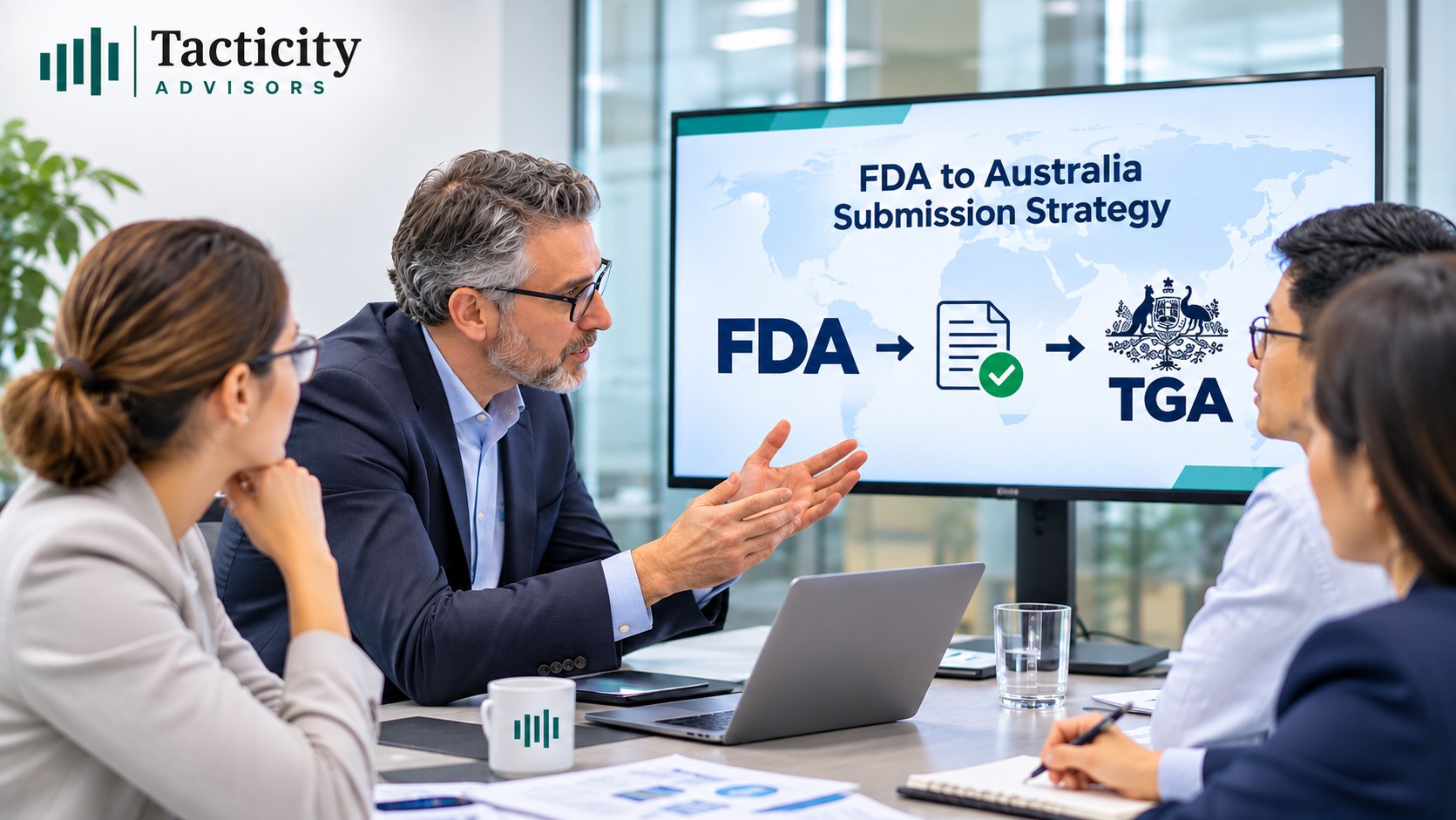
FDA clearance or approval is a U.S.-specific regulatory decision; it does not automatically authorize sale in Australia. For eligible devices, specified overseas regulatory decisions and supporting evidence may support an application for inclusion in the Australian Register of Therapeutic Goods (ARTG), subject to the applicable TGA pathway and requirements.
01 What Is the FDA-to-Australia Regulatory Strategy?
A medical device that has received FDA clearance or approval may already have a substantial body of technical and regulatory documentation behind it. When the manufacturer plans to enter Australia, the next question is how much of that work can support the Australian application.
The Therapeutic Goods Administration (TGA) has pathways that allow certain overseas regulatory decisions and assessments to be considered. However, the applicable requirements depend on the device, its classification and the evidence pathway.
For manufacturers, the work starts with reviewing the existing FDA decision, checking the evidence against Australian requirements and identifying what still needs to be addressed before applying for inclusion in the Australian Register of Therapeutic Goods (ARTG).
02 FDA Authorization Does Not Equal Australian Approval
The FDA and TGA operate under separate regulatory systems. FDA clearance or approval does not automatically result in ARTG inclusion. Before supplying a device in Australia, the manufacturer must satisfy the applicable Australian requirements and follow the relevant ARTG process.
| Regulatory Area | United States (FDA) | Australia (TGA) |
|---|---|---|
| Classification | FDA classification and applicable device rules | Australian medical-device classification under Schedule 2; IVD classification under Schedule 2A, as applicable |
| Local representation | U.S. Agent may be relevant for foreign establishments, depending on FDA requirements | Australian Sponsor generally required for overseas manufacturers seeking ARTG inclusion |
| Regulatory evidence | 510(k) clearance or PMA, depending on the device and pathway | Applicable TGA evidence pathway; overseas evidence may be considered where eligible |
| Labelling and IFU | Applicable FDA labelling requirements | Australian requirements and applicable Essential Principles |
| Post-market | Applicable FDA post-market obligations | Applicable Australian manufacturer and Sponsor obligations |
What this means in practice
Before preparing the Australian application, the manufacturer should confirm the device’s Australian classification, identify the applicable TGA evidence pathway, and check whether the FDA decision and supporting documentation meet the relevant requirements. Any differences in intended purpose, indications, labelling or device configuration should be assessed and documented. The manufacturer should also establish the Australian Sponsor arrangements and identify any outstanding Australian-specific requirements.
03 What FDA Evidence May Be Useful in Australia?
An FDA submission may already contain technical and regulatory documentation that can support an Australian market-entry strategy. Before generating new evidence, manufacturers should review the existing package and determine which documents are relevant to the applicable TGA pathway.
| Evidence Area | What to Review in the FDA Package | What to Check for Australia |
|---|---|---|
| FDA decision | 510(k) clearance, PMA approval or applicable decision documentation | Confirm relevance to the applicable TGA evidence pathway |
| Device description | Specifications, models, intended purpose and indications | Confirm the device and claims correspond to those proposed for Australia |
| Safety and performance | Bench testing, electrical safety, biocompatibility and other applicable test reports | Identify applicable Australian requirements not adequately addressed by existing evidence |
| Clinical evidence | Clinical data and literature supporting the device’s intended use | Check whether the evidence supports the proposed Australian intended purpose and indications |
| Risk management | Risk analysis, risk controls and residual-risk documentation | Review relevance and completeness against applicable requirements |
| Software and cybersecurity | Software validation and cybersecurity documentation, where applicable | Identify any additional evidence or documentation needed |
| Quality and manufacturing | Quality-system records and manufacturing documentation | Confirm applicable requirements and consistency with the device being supplied |
| Labelling and IFU | FDA labelling and Instructions for Use | Identify changes needed for Australian requirements |
| Intended population and demographic considerations | Intended population, demographics evaluated, and available safety and performance data | Assess population-specific differences and determine whether existing evidence is sufficient or additional data or justification is needed |
Record each evidence item as suitable for use, requiring further justification, or requiring additional work. Assign an owner and action to each identified gap.
04 From FDA Authorization to Australian Market Entry
Obtaining FDA clearance or approval is an important milestone, but manufacturers still need to establish the appropriate regulatory route for Australia.
The first step is to confirm the device’s Australian classification and identify the TGA evidence pathway that applies. The regulatory team can then determine which existing FDA documents may support the application and what additional Australian requirements need to be addressed.
Step 1 — Confirm the FDA decision and device
Identify the exact FDA decision and verify the device model, design configuration, intended purpose and indications it covers.
Step 2 — Determine the Australian classification
Classify the device under the applicable Australian rules. Do not assume the U.S. classification will be the same.
Step 3 — Identify the applicable TGA evidence pathway
Review the current TGA guidance to determine whether the FDA decision or supporting overseas assessment evidence can be used for the proposed application.
Step 4 — Review Manufacturer Evidence requirements
Determine which conformity assessment documentation is required and whether a Manufacturer Evidence identifier is needed for the device and pathway.
Step 5 — Complete the evidence gap assessment
Use the review in Section 03 to document evidence that can be used, documents that need further justification and requirements that remain outstanding.
Step 6 — Coordinate with the Australian Sponsor
Confirm the Sponsor arrangements and agree on the documentation and information required for the ARTG application.
Step 7 — Prepare the ARTG application
Compile the required evidence, address outstanding requirements and submit the application through the applicable process. Be prepared for any TGA assessment or audit that applies.
Step 8 — Plan for post-market compliance
Confirm the responsibilities of the manufacturer and Australian Sponsor for applicable reporting, recordkeeping and ongoing compliance obligations.
The work required at each stage depends on the device, its classification and the applicable TGA pathway.
05 Two Ways to Approach International Expansion
Option A: Sequential planning
U.S. FDA submission → Australia TGA/ARTG strategy → Other priority markets
Companies focus on one market at a time and assess additional markets after the initial submission. While practical, this approach may identify differences in classification, evidence requirements or labelling late in the process, potentially increasing costs and rework.
Option B: Multi-market evidence planning
Consider international regulatory requirements early in product development to support efficient evidence planning and reduce duplication.
- Identify target markets: Review the regulatory requirements of priority markets, including Australia.
- Plan evidence generation: Align design verification, validation, clinical evidence, risk management, software documentation, manufacturing records and labelling with applicable market requirements.
- Build the FDA submission: Maintain clear records of the FDA decision, device configuration and supporting evidence.
- Assess Australian requirements: Identify the applicable TGA pathway and determine which existing evidence may support the Australian application.
- Address evidence gaps: Identify additional documentation, data or justification needed for each market.
Considering Australia during product development and evidence planning can help manufacturers identify regulatory gaps early and coordinate Regulatory Affairs, Quality and manufacturing activities. Existing evidence may be reused when it relates to the same device and meets the applicable requirements; acceptance should not be assumed, and any reuse must be justified.
The objective is to minimise unnecessary duplication while ensuring that each target market’s regulatory requirements are adequately addressed.
06 Reviewing an FDA-Cleared Device for Australia
For a device with FDA 510(k) clearance, the Regulatory Affairs team identifies the applicable TGA evidence pathway and assesses the existing FDA documentation against Australian requirements. Any evidence gaps are documented, along with the additional data, documentation or justification required. This assessment supports Australian market-entry planning but does not guarantee acceptance of the evidence or ARTG inclusion.
| Evidence Area | Existing FDA Package to Review | TGA-Facing Action |
|---|---|---|
| Device identity and intended purpose | FDA decision, indications, model/version and configuration | Confirm alignment with the proposed Australian device and intended purpose. |
| Safety/performance testing | Relevant test plans, reports and conclusions | Map each report to the applicable Australian requirement; justify reuse or identify a gap. |
| Clinical evidence | Clinical data, literature review and claims supported | Check relevance to Australian intended purpose and identify any additional evidence needs. |
| Risk and software | Risk file, software validation and cybersecurity documentation | Check completeness, applicability and alignment with the Australian submission. |
| Quality/manufacturing | Quality-system and manufacturing records | Confirm applicable requirements and consistency with the device being supplied. |
| Labelling and local obligations | FDA labelling and IFU; post-market processes | Review Australian labelling, Sponsor responsibilities and post-market obligations. |
07 Responsibilities: Regulatory Affairs, Manufacturer and Sponsor
| Responsibility | Typical Action / Owner |
|---|---|
| Regulatory evidence strategy | Regulatory Affairs/consultant: identify the pathway, map FDA evidence to TGA requirements and maintain the gap assessment. |
| Device and evidence control | Manufacturer: confirm device identity, design/version, evidence traceability and change-control records. |
| Quality and manufacturing evidence | Manufacturer/Quality: provide applicable quality-system and manufacturing documentation and address identified gaps. |
| Australian application coordination | Australian Sponsor with the manufacturer: coordinate the ARTG application and required information under the applicable arrangements. |
| Post-market compliance | Manufacturer and Sponsor: define responsibilities for applicable Australian post-market and reporting obligations. |
08 Founder FAQ
Does FDA clearance automatically give access to Australia?
No. FDA clearance or approval does not automatically authorize sale in Australia. The applicable Australian requirements and ARTG inclusion process must still be followed.
Can every FDA 510(k) be used for an Australian application?
No. Eligibility depends on the specific FDA decision, device and applicable TGA evidence pathway. Check the current TGA criteria before relying on a 510(k) clearance.
Does FDA evidence eliminate the need to meet Australian requirements?
No. Eligible overseas evidence may support an Australian application, but applicable Australian requirements including classification, Essential Principles, labelling, Sponsor arrangements and post-market obligations must still be addressed.
Does using overseas evidence eliminate TGA fees?
Not necessarily. Using overseas regulatory evidence does not automatically eliminate Australian application or assessment fees. Confirm the applicable fees for the intended pathway.
09 Key Takeaway
FDA clearance or approval can provide a useful starting point for Australian market entry, but it does not replace the TGA process. Manufacturers should confirm the applicable pathway, assess the existing evidence against Australian requirements and resolve identified gaps before preparing the ARTG application.
Whether you are exploring Australia for the first time or expanding into new markets with an already authorised medical device, Tacticity Advisors can help you navigate the regulatory pathway and turn market opportunities into a clear, actionable strategy. Let’s talk about your global expansion plans.
10 Primary Regulatory Resources
- TGA — Using assessments from comparable overseas regulators for medical devices
- TGA — Overseas regulatory evidence options for a medical device application
- TGA — Australian regulatory evidence options for a medical device application
- TGA — Detailed comparable-overseas-regulator guidance, including IVDs
- Federal Register of Legislation — Therapeutic Goods (Medical Devices) Regulations 2002